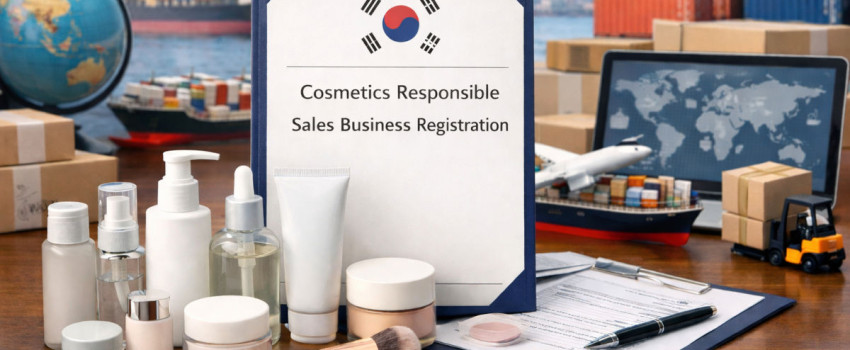
Foreign brands looking to source cosmetics from Korea often assume that export is mainly a logistics issue. In practice, it is not. In Korea, the customs and export role and the cosmetics regulatory role are separate. A freight forwarder or customs agent may handle the export declaration, but that does not replace the Korean cosmetics licensing and reporting framework. This distinction is one of the main reasons foreign buyers encounter delays after they have already selected a Korean supplier or OEM manufacturer.
1. KEY LICENSE
Under Korea’s Cosmetics Act framework, the Cosmetics Responsible Sales Business (화장품책임판매업) covers four main business types: (i) a registered cosmetics manufacturer that directly manufactures and then distributes or sells cosmetics, (ii) a party that distributes or sells cosmetics manufactured on consignment, (iii) a party that distributes or sells imported cosmetics, and (iv) certain e-commerce import-agency transactions. In other words, the business that takes responsibility for putting the product into commerce on the Korean side is the regulated party.
This is why foreign companies should not think of the Cosmetics Responsible Sales Business (화장품책임판매업) as a simple domestic sales license. It is broader than that. In Korea, it is the core license for the party that takes product responsibility for directly manufactured goods, OEM/ODM goods, and imported goods that are distributed or sold under the Korean system.
2. TWO REGISTRATIONS
A Korean cosmetics manufacturer may hold a Cosmetic Manufacturing Business registration (화장품제조업), which is the manufacturing registration. That registration is about the manufacturing site and facilities. The law requires a compliant work area, storage area, and quality-testing capability, although certain testing functions may be outsourced to qualified institutions. This is different from the Cosmetics Responsible Sales Business registration (화장품책임판매업), which is the registration for the business that assumes the quality, safety, reporting, and post-sale responsibility on the Korean side.
Accordingly, a foreign brand should never assume that “manufacturer” automatically means “fully registered to handle the Korea-side regulatory role for export or commercial distribution.” Some manufacturers hold both registrations. Some do not. That difference is commercially critical.
3. BRANDED VS. OEM
If a foreign company buys finished branded cosmetics from a Korean brand owner, the Korean seller will usually already operate through a Cosmetics Responsible Sales Business registration (화장품책임판매업). That structure is generally more straightforward. The more complex situation is OEM or ODM, especially where the overseas brand wants its own label, its own formula, or exports to several countries from Korea.
For OEM exports, Korean industry guidance is quite direct: when a Korean manufacturer receives an OEM order from an overseas company and exports the goods directly, that Korean manufacturer should hold a registered Cosmetics Responsible Sales Business (화장품책임판매업) and file the required production report. If the OEM is instead supplied to a separate Korean company holding a Cosmetics Responsible Sales Business registration (화장품책임판매업), then that company handles the reporting. This is one of the clearest indicators that export from Korea is not treated as a purely freight-forwarding matter.
4. 3PL IS NOT ENOUGH
From a customs perspective, Korea allows an export agent to file the export declaration, while the cargo owner or exporting party remains the relevant exporter or cargo owner for customs purposes. That means a 3PL, customs broker, or export agent can play the logistics and customs role. However, that customs role does not automatically satisfy the cosmetics licensing role under the Cosmetics Act.
For foreign brands, the practical takeaway is simple: do not confuse customs execution with cosmetics regulatory eligibility. A forwarder can move the shipment. A Korean company holding the appropriate Cosmetics Responsible Sales Business registration (화장품책임판매업) must still sit in the correct regulatory position if the transaction structure requires Korea-side product responsibility, reporting, or certificate issuance.
5. WHY IT IS NOT SIMPLE
Many overseas companies initially consider setting up their own Korean entity and obtaining a Cosmetics Responsible Sales Business registration (화장품책임판매업) themselves. Legally, that can be possible, but it is not a light-touch registration. The applicant must register a specific Korea-side business office with the competent regional MFDS office, submit internal standards for quality control and post-sale safety management, and appoint a qualified Responsible Sales Manager (책임판매관리자) whose qualifications meet the legal criteria.
The qualified manager requirement is especially important. Korean law requires the Responsible Sales Manager (책임판매관리자) to be a person with recognized qualifications, such as a doctor, pharmacist, a relevant science-degree holder, or a person with specified cosmetics manufacturing or quality-control experience. In addition, the Responsible Sales Manager must complete initial and annual recurring education. This is why the registration typically requires real local capability, not just a paper company.
In practical terms, this means a foreign brand usually needs more than incorporation alone. It needs a real Korea-side operating setup: a registered local business location under the jurisdiction of the relevant regional MFDS office, a qualified Responsible Sales Manager, and working internal compliance procedures. That burden is often disproportionate for brands that only need sourcing or export support rather than a full Korean market-entry platform.
6. REPORTING AND CERTIFICATES
Korean companies holding a Cosmetics Responsible Sales Business registration (화장품책임판매업) must report production or import performance and, for applicable products, the raw material list under the Cosmetics Act framework. The law requires the raw material list to be reported before distribution or sale, and Korean industry systems make clear that annual production reporting also applies to products made in Korea for distribution or sale, including export. This is another reason the Korea-side registered entity matters even when the ultimate buyer is overseas.
Separately, Korean industry systems for export certificates state that a Korean manufacturer or a Korean company holding a Cosmetics Responsible Sales Business registration (화장품책임판매업) uses the certificate issuance system for cosmetics manufactured in Korea and exported overseas. In many transactions, these certificates are not optional from a commercial perspective because overseas importers, banks, customs authorities, or local distributors request them.
7. KEY BODIES
For licensing and registration, the main regulator is the Ministry of Food and Drug Safety (MFDS), usually through the competent regional MFDS office based on the local business site. Registration and changes are handled through the MFDS electronic system, NEDRUG (의약품안전나라). For annual reporting and many export-certificate functions, the Korea Cosmetic Association (대한화장품협회, KCIA) is a key operational body. For some import-side functions and certain education routes, the Korea Pharmaceutical Traders Association and the Korea Institute of Cosmetic Industry also appear in the official guidance. Customs clearance and export declaration remain a separate track handled through customs agents, brokers, or freight forwarders.
8. COMMON CASES
Scenario 1: Buying finished Korean branded products for export. Confirm that the Korean seller already holds the appropriate Korea-side cosmetics registration and can issue the required export documents. In many cases this is the cleanest structure.
Scenario 2: OEM/ODM manufacturing in Korea where the manufacturer also holds a Cosmetics Responsible Sales Business registration (화장품책임판매업). This is often workable, provided the Korean manufacturer is willing to remain the Korea-side registered party for reporting and export-document purposes.
Scenario 3: OEM/ODM manufacturing in Korea where the manufacturer does not hold a Cosmetics Responsible Sales Business registration (화장품책임판매업). This is where foreign brands usually need a separate Korean intermediary or agency that already holds the required registration. The missing piece is not merely shipping support; it is the Korea-side registered party that can properly sit in the regulatory and reporting structure.
Scenario 4: Importing finished cosmetics into Korea for local sale. This is also squarely within the scope of the Cosmetics Responsible Sales Business (화장품책임판매업) because imported cosmetics distributed or sold in Korea fall within that category. The foreign manufacturer cannot simply bypass the Korean responsible sales framework.
9. BEST STRUCTURE
For many foreign brands, setting up a local Korean company can be the right step because it helps address brand ownership, product ownership, and transaction control on the Korea side. However, setting up a Korean entity alone does not solve the problem. Without the relevant cosmetics registration, that entity still cannot properly perform the Korea-side regulated sales and distribution role.
At the same time, many Korean agencies that support import and export transactions either cannot work directly with foreign companies or prefer not to do so. In practice, this means the workable structure is often either: (i) establishing a Korean local company and engaging a licensed Korean agency, or (ii) working through a specialized trade agency that can design and manage a compliant third-party transaction structure between the foreign brand, the Korean supplier or manufacturer, and the licensed local party. Learn more about KOISRA UP Outsourcing and Local Contractor Management in Korea, a practical solution for foreign companies that need local coordination, contractor management, and support in structuring compliant Korea-side transactions.
This is particularly important where one foreign brand wants to source from multiple Korean suppliers, export to multiple destination countries, or keep tighter control over branding and ownership without building a full Korean regulatory platform from scratch.
In short, foreign companies should view Korean cosmetics transactions through two separate lenses: first, who is filing the shipment; second, who is legally sitting in the Korea-side cosmetics role. In Korea, those are not the same questions. If the supplier or manufacturer does not hold the necessary cosmetics registration, the practical route is often to build the right Korea-side transaction structure instead of assuming that a 3PL or forwarder can solve the issue alone.
Note: This is a general market insight based on current Korean legal and industry guidance, not a formal legal opinion for a specific transaction. The exact structure should still be checked against the products, contract flow, exporter-of-record setup, and destination-country import rules.
