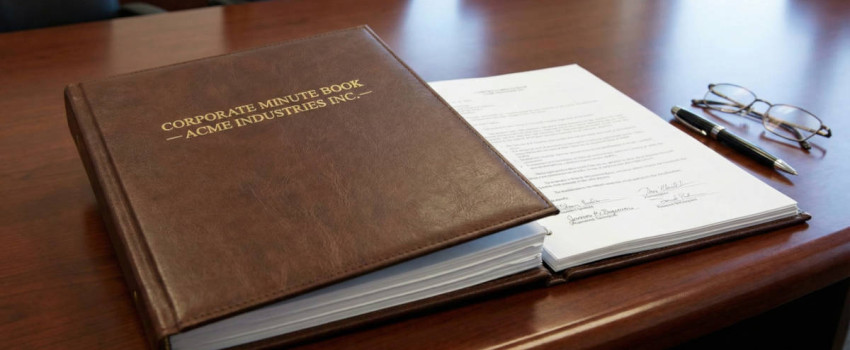
Corporate minute books are more than internal notes. In Korea, properly prepared and retained minutes of shareholder meetings and board of directors’ meetings are a legal obligation under the Korean Commercial Act and a key source of evidence in audits, disputes and due diligence.
What is a corporate minute book in Korea?
In the Korean context, a “corporate minute book” usually refers to a set of bound or systematically organised records that includes at least:
- Minutes of ordinary and extraordinary general meetings of shareholders (including the AGM). See also our article on Annual General Meeting (AGM) Requirements in Korea.
- Minutes of board of directors’ meetings. See also our article on Board of Directors’ Meeting Obligations in Korea.
- In some companies, minutes of audit committee meetings or other statutory committees, where applicable.
- Supporting corporate records such as shareholder registers and updated Articles of Incorporation, which are part of the wider statutory books framework described in our article on Statutory Books and Corporate Registers Requirements in Korea.
Core legal framework for minute books
- Minutes of general meetings of shareholders
Article 373 (Minutes of General Meetings) requires that minutes be prepared for general meetings of shareholders, stating at least a summary of the course of the meeting, the substance of resolutions and any objections, and that such minutes be signed or sealed by the chairperson and directors present. These minutes form part of the company’s permanent records.
- Minutes of board of directors’ meetings
Article 391-3 (Minutes of Board of Directors’ Meeting) requires minutes to be prepared for board meetings, recording the agenda, the gist of discussions, the outcome of resolutions, and the identity and reasons of dissenting directors. The minutes must bear the names and seals or signatures of attending directors and auditors. Shareholders are given rights to inspect or obtain copies of board minutes during business hours, subject to limited grounds for refusal.
- Retention and disclosure at the principal office
Article 396 (Obligation to Retain and Disclose Articles of Incorporation, etc.) requires directors to retain the articles of incorporation and the minutes of general meetings of shareholders at the principal office and each branch office, and to retain the shareholder register and bond register at the principal office. Shareholders and creditors may, during business hours, request inspection or copies of these documents.
- General obligation to preserve trade books and important documents
Article 33 (Preservation of Trade Books, etc.) establishes that every merchant must preserve trade books and all important business documents for ten years, and documents supporting entries in the trade books for five years. In practice, corporate minute books are treated as “important documents” that should be preserved for extended periods.
- Administrative fines for failures in record-keeping and disclosure
Article 635 (Acts Subject to Administrative Fines) provides that directors and other responsible persons may be subject to administrative fines (up to five million won in many cases) if they neglect to make a required registration or public notice, refuse without good cause to permit inspection or copying of documents such as minutes, or fail to keep or correctly complete statutory books, minutes, reports and financial statements as prescribed by the Act.
Why minute books matter in practice
Properly maintained minute books are critical for several reasons:
- Evidence of valid corporate decisions: Minutes provide contemporaneous proof that shareholder and board decisions were taken with proper quorum, voting procedures and notice, in line with the Commercial Act and the company’s Articles of Incorporation.
- Protection of directors and officers: Well-drafted minutes documenting discussions, questions and dissenting opinions can help show that directors fulfilled their duty of care and loyalty when later challenged by shareholders or regulators.
- Shareholder and creditor rights: Under Articles 373, 391-3 and 396, shareholders (and in some cases creditors) can request inspection or copies of minutes. Organized minute books make it easier to respond correctly and avoid disputes over access.
- Due diligence and M&A: In corporate transactions, acquirers and investors routinely review minute books to verify approvals of key contracts, capital increases, loans, guarantees, share option plans and other major decisions.
- Regulatory and tax audits: Regulators and tax authorities may request board and shareholder minutes when reviewing specific transactions, dividend decisions or related-party dealings.
What should be recorded in Korean minutes?
Although formats vary, Korean corporate minutes generally include at least:
- Company name, type of meeting (AGM, extraordinary general meeting, board meeting) and meeting date, time and place.
- Names of the chairperson, directors, auditors and, for shareholders’ meetings, presence or representation status of shareholders.
- Agenda items and a clear description of each matter submitted to the meeting.
- A summary of the discussions and key points raised, especially where there are significant risks, conflicts of interest or alternative proposals.
- The text or substance of each resolution and whether it was approved or rejected.
- Dissenters and their reasons, in line with Article 391-3 for board meetings and the general principles for documenting objections at shareholder meetings.
- Signatures or seals of the chairperson and participating directors (and auditors, where required).
Minute books and statutory books: how they fit together
Minute books do not stand alone; they are part of the wider statutory record-keeping framework. In addition to minutes, Korean companies must maintain shareholder registers, bond registers (where applicable), Articles of Incorporation and trade books and must preserve them for the periods set by the Commercial Act and tax laws. For a more detailed overview, see our article on Statutory Books and Corporate Registers Requirements in Korea.
In practice, well-structured minute books and statutory books make it easier to demonstrate that share issuances, director appointments, capital changes and major transactions were approved in the correct order and recorded consistently across all corporate documents.
Common weaknesses in Korean minute books
- Minutes that are extremely short, recording only “approved as proposed” without explaining what was proposed or why.
- Missing or incomplete signatures and seals, calling into question the formality of the meeting.
- Minutes stored only in email or loose electronic files, rather than in a coherent, chronological minute book at the principal office.
- No clear record of dissenting directors or their reasons, even where Articles 391-3 expects these to be recorded.
- Minute books kept only in English at overseas headquarters, with no Korean or bilingual versions accessible at the Korean principal office.
Practical tips for foreign-invested companies
- Use bilingual (Korean/English) minute templates for shareholder and board meetings to reduce translation disputes and align group and local requirements.
- Keep an indexed minute book in Korea, with clear references to supporting documents (financial statements, contracts, resolutions) stored in an organised manner.
- Make sure meeting agendas, resolutions and minutes are consistent with the Articles of Incorporation and any board or committee regulations.
- Coordinate with external auditors and legal counsel so that minute books support financial reporting and compliance narratives.
How KOISRA UP can help
KOISRA UP helps foreign-owned companies in Korea design and implement practical minute book systems that satisfy the Korean Commercial Act while remaining usable for management and overseas headquarters. We prepare bilingual minute templates, support the drafting of AGM and board minutes, and work closely with Korean lawyers, CPAs and judicial scriveners so that your minute books align with statutory requirements, withstand regulatory scrutiny and support future transactions.
This article is part of KOISRA UP’s Corporate Secretarial & Governance Services series. To learn more about our support for corporate minute books, AGMs and board meetings in Korea, please visit our Corporate Secretarial & Governance Services in Korea page.
This Insight is for general information only and does not constitute legal, tax or accounting advice. The application of Korean law depends on the specific facts of each case. Before taking any action, you should obtain advice from a qualified Korean lawyer, CPA or other professional adviser who understands your circumstances.
